
Modular Data Centers in 2026: Infrastructure Discipline, AI Demand & Near-Term Opportunity
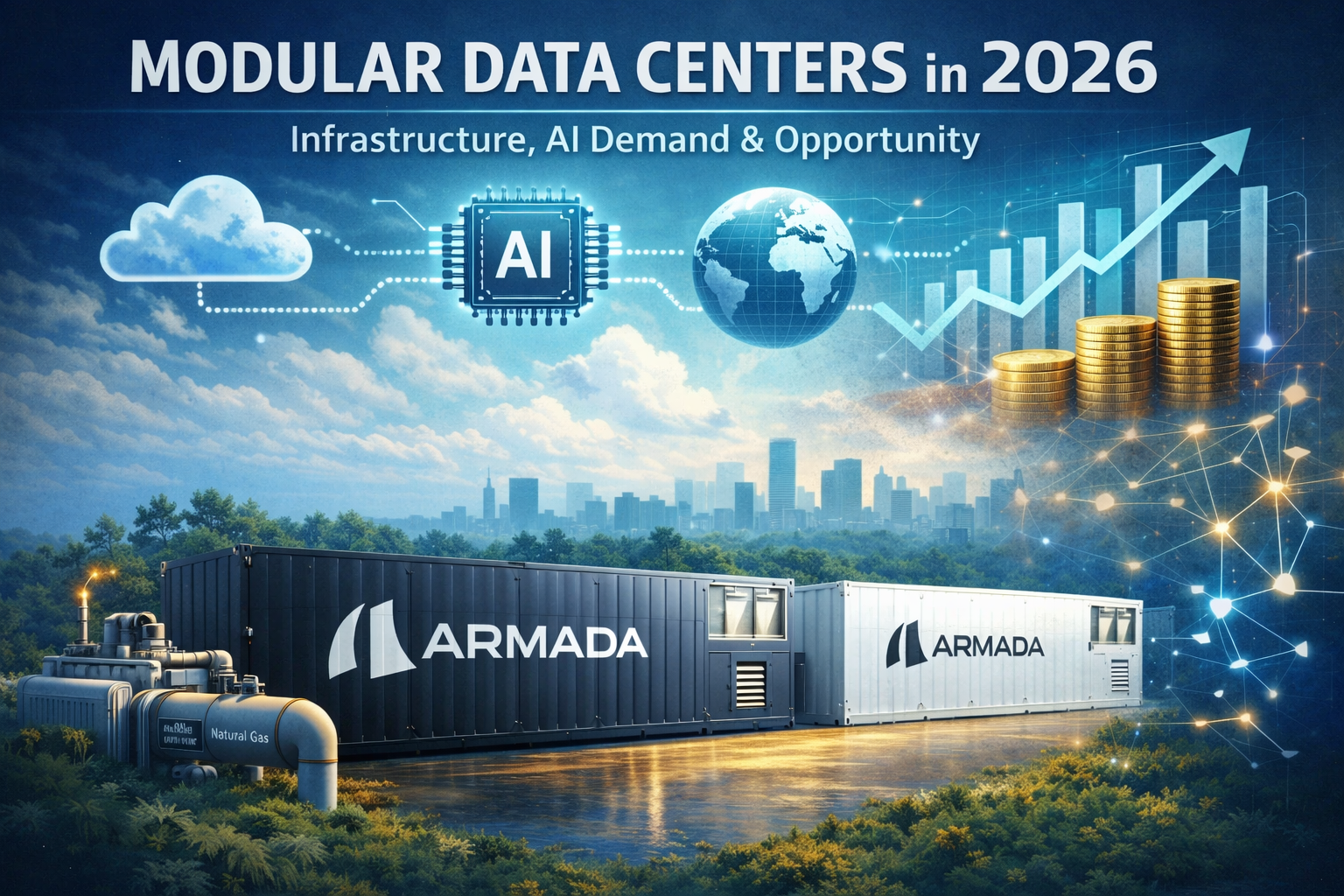
Modular data centers are rapidly emerging as one of the most practical solutions to meet the accelerating global demand for compute.
Driven by artificial intelligence, cloud expansion, and high-performance workloads, digital infrastructure requirements are growing faster than traditional data center development timelines can accommodate.
In 2025, the convergence of modular design, energy strategy, and disciplined financing is creating a compelling near-term opportunity for infrastructure-focused operators and investors alike.
For Mindstream, LLC d/b/a Mindstream Energy, these trends support a strategy centered on deploying modular data center infrastructure working with Armada.AI.
- Modular Data Centers Solve the Speed-to-Market Challenge
Traditional data centers often require years to permit, construct, and energize. Modular data centers fundamentally change that equation.
By leveraging factory-built, containerized systems, modular deployments can be installed rapidly, scaled incrementally, and optimized as demand evolves. This speed-to-market advantage is increasingly critical as AI and edge-compute workloads expand faster than centralized infrastructure can support.
For operators, modularity reduces execution risk and capital lock-up. For investors, it shortens the timeline between capital deployment and revenue generation, a key characteristic of income-oriented infrastructure strategies.
- Energy Strategy Has Become Central to Compute Strategy
Compute demand is no longer constrained by servers alone; it is constrained by power.
Access to reliable, low-cost energy has become one of the most decisive factors in determining where data centers can be built and operated economically. Mindstream Energy’s access to low-cost natural gas enables a differentiated deployment model that pairs modular data centers with a predictable, dispatchable energy supply.
This energy-aligned approach:
• Reduces exposure to grid congestion and pricing volatility
• Supports predictable operating costs
• Extends the economic life of data center assets
As energy markets tighten globally, this integration is increasingly viewed as a competitive and institutional advantage.
- AI Is Driving Demand for Distributed, Modular Compute
Artificial intelligence workloads — particularly inference, edge processing, and region-specific compute, are accelerating demand for smaller, distributed data center footprints rather than centralized hyperscale facilities alone.
Working with Armada.AI, Mindstream Energy is positioned to deploy modular data centers tailored to:
• AI and high-performance computing workloads
• Energy-constrained regions
• International markets with limited grid capacity
This partnership aligns infrastructure, software, and energy into a unified deployment strategy, reducing integration risk and improving time-to-revenue.
- Capital Markets Are Favoring Infrastructure-Style Financing
As modular data centers mature into a recognized infrastructure asset class, capital markets are increasingly favoring structured financing over speculative equity models.
Fixed-rate bond instruments offer accredited investors:
• Defined terms and income visibility
• Capital aligned with near-term deployment
• Exposure to infrastructure economics without equity dilution
- Near-Term Catalysts Support Deployment
Several near-term factors reinforce the opportunity for modular data center deployment:
• Continued growth in AI and cloud demand
• Grid constraints driving off-grid and hybrid solutions
• Increasing acceptance of modular and containerized infrastructure
• Expanding international demand for localized compute
Collectively, these dynamics favor operators capable of executing quickly, managing energy effectively, and financing growth responsibly.
Conclusion: Modular Data Centers as Durable Infrastructure
In 2025, modular data centers are no longer experimental; they are becoming essential infrastructure.
When paired with low-cost energy, disciplined deployment, and structured financing, modular data centers offer a scalable, cash-flow-oriented pathway for growth. For Mindstream Energy, the combination of modular deployment, collaboration with Armada.AI, and financing reflects a broader industry shift away from speculative buildouts and toward durable, energy-backed digital infrastructure.
As global compute demand accelerates, execution, not scale alone, will define success.
This content is for informational purposes only and does not constitute an offer to sell or a solicitation to buy securities; any offering is made only to verified accredited investors pursuant to applicable securities laws.