
What If Your AI Data Center Paid for Itself Before It Was Finished?
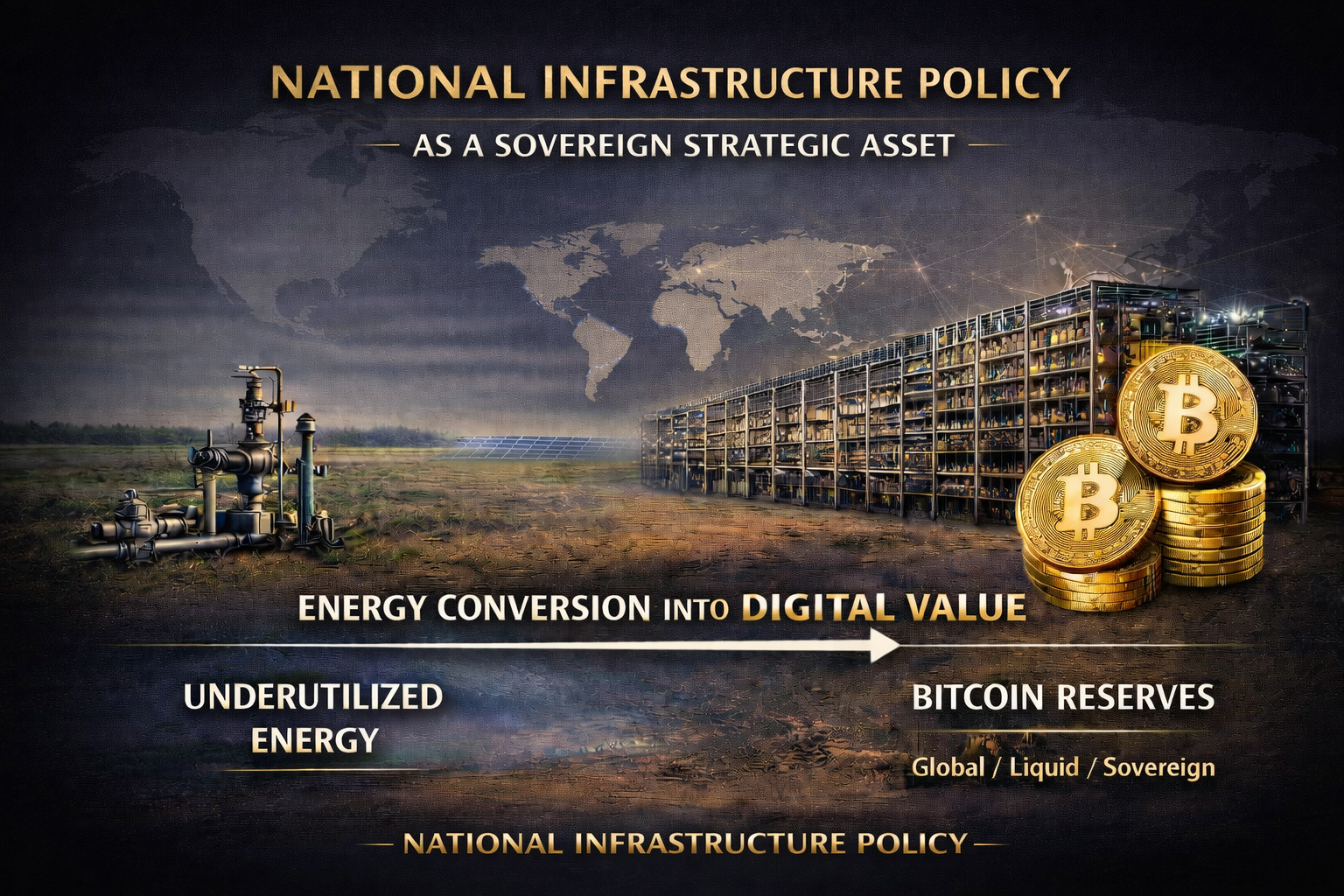
Bitcoin Mining as a Sovereign Strategic Asset
Bitcoin mining is one of the most misunderstood industries in the world, and it is misunderstood most profoundly by the very institutions best positioned to benefit from it: sovereign nations with abundant domestic energy.
That misunderstanding is costing governments real money, real geopolitical leverage, and a generational opportunity to build wealth-generating digital infrastructure at precisely the moment when the global economics make it most compelling.
This is an attempt to correct that misunderstanding.
Strip Away the Noise
The public conversation about Bitcoin mining has been shaped by three distortions: the speculative framing of cryptocurrency markets, the environmental controversy over energy use, and the association of mining with retail investors and offshore operators. Each of these frames contains a grain of truth. None of them is the right lens for a national energy ministry or a sovereign wealth fund.
Strip them away, and what remains is a remarkably clean industrial proposition.
Bitcoin mining is an energy conversion business. You take electrical power — ideally power that is stranded, underutilized, or available at low cost — and you convert it into a digitally native, globally liquid financial asset. The output is not a manufactured good that requires warehousing, a commodity that requires physical delivery, or a service that requires ongoing customer relationships. The output is a unit of value that is instantly transferable anywhere in the world, denominated in an asset with a fixed and publicly auditable supply.
For a national energy ministry, this reframing matters enormously. Bitcoin mining is not a tech investment. It is an energy monetization strategy.
The Industrial Logic
The economics are straightforward. The profitability of Bitcoin mining is determined primarily by two variables: the price of the asset mined, and the cost of the energy consumed to mine it. Hardware costs, operational costs, and financing costs matter — but they are secondary to the fundamental energy equation.
This creates a structural advantage for energy-rich markets that no amount of capital or technical sophistication can replicate elsewhere. A mining operation running on domestic natural gas at $0.065 per kilowatt-hour has a cost structure that a data center in Northern Virginia or Frankfurt simply cannot match. That cost advantage is durable, defensible, and, critically, sovereign. It is not subject to the pricing decisions of a foreign cloud provider, the regulatory environment of another jurisdiction, or the geopolitical exposure of a supply chain that crosses multiple borders.
The comparison to traditional resource extraction is instructive. When a nation pumps oil from the ground, it earns revenue denominated in US dollars, subject to oil price volatility and the leverage of global commodity markets. When a nation converts its domestic gas into Bitcoin, it earns revenue denominated in an asset with a fixed supply cap, no single point of control, and liquidity in every financial market on earth. The energy is the input. The sovereignty is the output.
Stranded Energy and the Flexibility Premium
One of the most compelling applications of Bitcoin mining for energy-producing nations is the absorption of stranded energy, power that is generated but cannot be consumed at the moment of production due to grid constraints, demand mismatches, or geographic isolation.
Every energy market in the world faces this problem. Excess power from gas wells that are too remote for grid connection. Wind and solar generation that peaks when demand is low. Flare gas that is burned off at the wellhead because pipeline capacity is insufficient. In conventional energy economics, stranded power is waste. There is no mechanism to recover its value.
Bitcoin mining changes that calculus entirely. A mining facility can be switched on and off within seconds in response to grid signals, consuming excess power when it is abundant and curtailing when the grid needs relief. This flexibility makes mining one of the only industrial loads that can profitably co-locate with intermittent, stranded, or otherwise unmonetizable energy sources. The technical term for this is demand response. The economic reality is that mining converts waste energy into stored value.
For nations sitting on gas fields that are too remote to connect to a national grid, or renewable capacity that exceeds domestic demand, Bitcoin mining is not an afterthought. It is the monetization strategy.
Infrastructure Policy, Not Speculation
The reputational overhang of Bitcoin’s speculative history has made it difficult for policymakers to engage seriously with mining as an infrastructure question. That overhang is lifting, partly because institutional adoption has normalized the asset class, and partly because the strategic logic of sovereign mining capability is becoming impossible to ignore.
The nations that understand this first are not speculating. They are building industrial infrastructure that generates revenue, creates technical employment, develops domestic expertise in energy management and digital systems, and positions the country at the intersection of two of the most consequential global trends of the next two decades: the energy transition and the digitization of value.
The nations that dismiss Bitcoin mining as a speculative technology play are, in effect, leaving energy monetization on the table. They are passing on the opportunity to convert their natural resource endowment into a globally fungible digital asset, an opportunity that grows more valuable, not less, as the global Bitcoin network expands and the fixed supply cap becomes more relevant to institutional investors worldwide.
What This Means for Energy-Rich Emerging Markets
At Mindstream Energy, our thesis is specific: the most compelling Bitcoin mining opportunity in the world today is not in North America or Northern Europe. It is in energy-rich emerging markets where domestic gas resources are abundant, grid infrastructure is developing, and national leadership is actively looking for pathways to economic diversification and digital economy development.
These are markets where the energy cost advantage is real and durable. Where the economic development argument is genuine, mining creates high-skill employment, technology transfer, and a base of digital infrastructure expertise that compounds over time. Where the sovereign case is strongest, because building this capability domestically means the value stays in-country, the expertise stays in-country, and the infrastructure serves national priorities rather than foreign commercial interests.
Natural gas available at the wellhead. A government that has articulated a clear digital economy vision. A technical workforce ready to be trained and deployed. The mining infrastructure we are building will not export energy resources to generate returns for foreign shareholders. It will convert natural gas into digital assets..
That is infrastructure policy. And it is exactly the kind of policy that forward-looking energy-rich nations should be developing right now.
The Window Is Open But Not Indefinitely
The structural advantages available to low-cost energy producers in Bitcoin mining are real today and will remain real for the foreseeable future. But the window for first-mover advantage in establishing sovereign mining capability is finite. As more nations recognize the strategic value of domestic mining infrastructure, the competition for equipment, technical expertise, and favorable regulatory frameworks will intensify.
The nations that move now, that treat Bitcoin mining as the energy infrastructure play it is, rather than the speculative technology bet it has been characterized as, will be the ones that capture the compounding returns: financial, strategic, and developmental.
The noise around Bitcoin has obscured something simple and important. Mining is an industrial business. Energy is the input. Sovereignty is the output.
For energy-rich nations, that is not a speculative bet. It is a strategic imperative.
For inquiries: mthimmig@mindstreamenergy.com |
Explore how our dual-revenue infrastructure model works at MindstreamEnergy.com.